shelves

shelves

Friday, July 24, 2026

Experiments in SciFi and Fantasy (and Hello again, Third Culture Literature: It has been a long time)

I am reading Lois McMaster Bujold's Shards of Honor as a favor for a friend, and I still have Ursula K. LeGuin's Lathe of Heaven on the go ( for those following along, that means War and Peace is neglected for the moment, though I made it as far as the wolf-hunting part, which is roughly half way).

Anyway, Bujold writes "Radial symmetry was popular among the tiny creatures occupying the ecological niches held by insects on Earth" (17) and "Do you think they could be like those birds from Earth, that pick parasites off cattle?" (21).  

LeGuin writes about Dr. William Haber's office in Portland:  "It did not have a view of Mount Hood [. . .] But on one of the walls was a big photographic mural of Mount Hood" (6).  It is the absence of this mural that first signals the world-changing effect of Orr's dreams (24-5).

These two incidents of the unfamiliar fantastic and scientific compared to Earth (radials, Mount Hood) together made me think "Huh.  Interesting.  I bet a TCK wouldn't compare the current world with a past one.  I bet they'd just occupy the new world, without comparison."  

So, I set up a little experiment re: world-building to see if I was right.


SciFi (We are on spaceships, new planets and all that):

Bujold's Shards of Honor  vs. CCK Nnedi Okorafor's Binti


Fantasy (We are on Earth, but its crazy different.  )

LeGuin's Lathe of Heaven vs TCK Mohsin Hamid's Exit West


I need to do more work on this.  I got blindsided by my second migraine of the week (after swimming which is so virtuous I ought to be radiating health, but I am not) so this is very preliminary.


Guys.  The results of my experiment are surprising.  I expected an absence of comparison in Hamid and Okorafor.  I expected their characters to just get on with being in the new places.  What I may have found instead is the introduction of that ever-mind boggling extra dimension: TIME.


Okorafor roots Binti in a fantasy of the past (ancestral land) as well as a science fiction of the future (launch port)  when she has Binti muse "We Himba don't travel.  We stay put.  Our ancestral land is life; move away from it and you diminish.  We even cover our bodies with it. Otjize is red land.  Here in the launch port, most were Khoush.  [. . . ] Here I was an outsider" (3).

Hamid describes portals through which migrants travel from one part of earth to another.  Migrants cross immense geographic and cultural distance in an instant.  However, the past get left behind, and all the people in it.  "When we migrate, we murder from our lives those we leave behind" writes Hamid (98), and adds "We are all migrants through time " (209).

It brings us back to Salman Rushdie's "Imaginary Homelands": "The past is a country from which we have all emigrated.  It's loss is a part of our common humanity" (12).  

It's true.  We all do leave the past behind.  

However, an early response to my hasty experiment is that SciFi and Fantasy contrasts "home" places (ancestral lands, Earth, which is home for Bujold's readers if not for protagonist Cordelia Naismith) with imagined ones, without much considering how the home places are necessarily also past places.

CCK and TCK SciFi and Fantasy cannot seem to help themselves in thinking about the importance of the past as it informs the future, and in so doing, reminds us of how irrevocably it is lost to us. Time  as a metaphor for distance from place is of the essence.


Addendum (the good bit, actually.  Best thoughts below):


Perhaps you are infuriated by the Ford Escalade sized hole in this argument?  I received this text at about 6.20 AM, from a good friend who is also a good scientist, and a good reader: 

"George Orr’s dreams [Lathe of Heaven] change the past. That’s the entire premise. Not just for him, but for everyone. "

Doh!

On the one hand: throw this laptop out the window melodramatically for that is correct

BUT!

On the other hand: why did LeGuin's writing about the past automatically feel different to me?


Giving myself benefit of the doubt for a second led to this insight: I am  indeed wrong  in my conclusion "CCK and TCK SciFi and Fantasy cannot seem to help themselves in thinking about the importance of the past as it informs the future."  No.  Not correct.  TCK and CCK SciFi show a separation between past and present.  The past is a vision with no direct connection to the present.  The past does not cause the present.  That's the problem really: the rupture between past and present leads to nostalgia for something to which there is no chain of connection from the present.

In LeGuin, you do see how the past informs the present.  Over and over again different pasts inform the present in different ways.  For LeGuin, the focus is on the present, on the ramifications of a tweak to something in the past.  Causality is everything.  The past causes the present.  The present, as outcome of altered past, is relentlessly the focus.

To belabor the point, in CCK and TCK work, the past does NOT cause the present.  Rushdie opens his essay with: "An old photograph in a cheap frame hangs on a wall in the room where I work. It's a picture dating from 1946 of a house into which, at the time of its taking, I had not yet been born" (9).  The past is a relic, static, fetishized even.  It bears no resemblance to the present, and how it connects with the present at all is the mystery because it does not seem to have any bearing on it whatsoever.


Wednesday, May 21, 2025

I've started a new blog

 Come find me over here:

https://whatsantjereading.blogspot.com/


Reading

For Better Posture, World Peace, and Improved Dentition.

Friday, March 1, 2024

I wrote a novel. Today is its publication day!


"But Antje," you ask, "Where the heck have you been?"

Among other things, I have been writing fiction.  

Slow Time is published by spuyten duyvil press.  

It is TCL in a way similar to Pearl S. Buck's The Good Earth in that it presents a kind of fantasy of belonging, of being claimed by a place.  It does have a military brat character.  Also, were I to analyze it as though I had not written it myself, it does bear many of the hallmarks of third culture literature, even when third culture literature doesn't seem to be about traveling.

Buy it here: https://www.spuytenduyvil.net/slow-time.html


Thursday, June 9, 2022

Memoirs

 I was very fortunate to present with Dr. Jessica Sanfilippo-Schulz in a talk for the World Food Programme's Family Liaison Outreach Community (FLOCK).  Our work was on TCK and CCK memoirs.


Here are some of the books I spoke about and some I would have spoken about if I had had more time:


I started with Salman Rushdie's Imaginary Homelands (1981), which is essays not memoir per se.  The titular essay, "Imaginary Homelands" has some lovely lines about geographic and temporal distance meaning that what is remembered as "home" is actually fictional.  Rushdie is not strictly TCK, though definitely multiply displaced (India, Pakistan, The UK, years in hiding from the fatwa, the United States).

I paired him with Michael Ondaatje's family history Running in the Family (1982)--for Ondaatje, trying to piece memories together requires collaboration.  Ondaatje is TCK (former Ceylon, now Sri Lanka, UK, Canada).


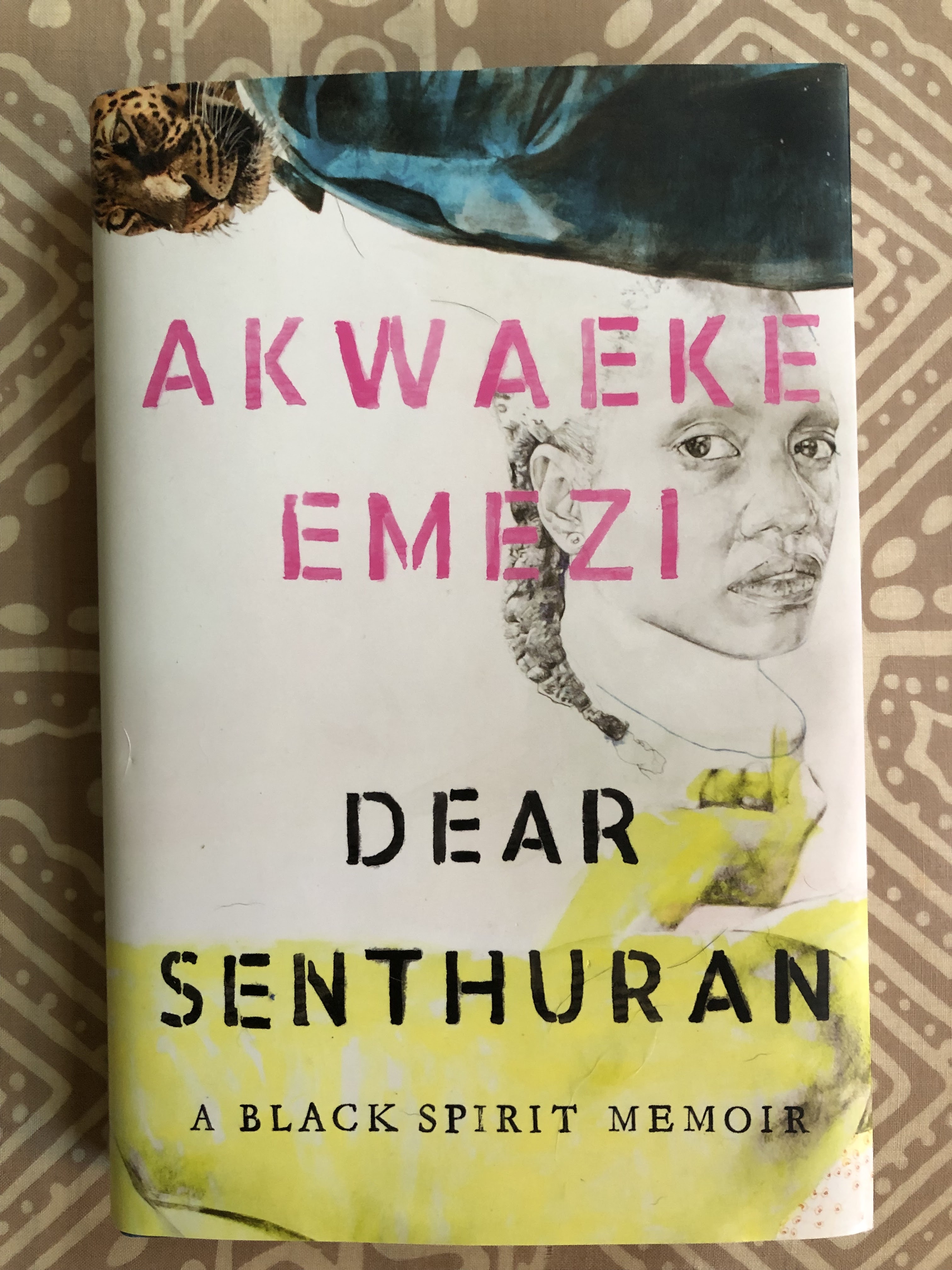
Akwaeke Emezi's memoir Dear Senthuran (2021) considers the result of multiple moves (nothing and no one seems real after a while).  Here (as in their autobiographical novel Freshwater), Emezi is interested in the psychology of ogbanje.  Their work makes me feel as though my brain is melting . . . a good thing in small doses.  Emezi is Malaysian/ Sri Lankan/Nigerian/ American.


Jane Alison's 2009 memoir is . . . astonishing.  It concerns an American and an Australian diplomatic family in which there is a partner (for Alison, a parent) swap.  Alison is Australian/American and her bio sometimes refers to her as "raised in the foreign service" which is interesting shorthand for a TCK upbringing.


Heidi Sand-Hart's Home Keeps Moving (2010) is a memoir of being raised a missionary kid in England, India and Norway.  She explicitly engages with TCK vocabulary, unlike the other authors I mention.  She is also the only one of the authors I have mentioned so far who is not also a successful novelist.  It shows in the prose style, which is more rawly confessional.


I threw in some novels too, because of how they catch autobiographical detail.  Yann Martel's The High Mountains of Portugal (2016) which I found peripatetically charming, and which features a mis- matched relationship between a chimpanzee and an Iberian rhinoceros.  I have written about this before.

I have written about Ondaatje's The Cat's Table academically.  I used it in the FLOCK talk because details about the Oronsay, and the protagonist's age when sailing alone on it from Ceylon to England are so exactly depictions of Ondaatje's own past.

I have never written on Azareen Van der Vliet Oloomi.    Her work would pair very well with Yann Martel's, actually.  Call Me Zebra (2018) is rife with TCK and CCK themes.  Oloomi has other novels too.


I ended with some words from Pico Iyer (card-carrying TCK).  His Global Soul (2000) is iconic in writing about travel and dislocation.  

And finally, Aminatta Forna's The Devil that Danced on Water (2002).  I suspect her very recent The Window Seat would have excellent material too.


Ideally, especially for the World Food Programme audience, I would have liked to consider a couple of TCK travel narratives, perhaps jumping off from the award winning blogs listed on this site and my own work from years ago on that topic.  Something I have yet to investigate is TCKs in international aid writing memoirs.  I know those must exist, but haven't put the work into hunting them down yet.  I can recommend non-TCK Jessica Alexander's Chasing Chaos: My Decade In and Out of Humanitarian Aid (2013) as an interesting starting point in that genre.

And what about Ottessa Moshfegh's amazing Homesick for Another World (2012).  Short stories.  Love them.  Why have I not written about them yet?

In the FLOCK talk, I plugged my own book.  Here it is:


It deals with seventeen TCK fiction writers, and has a good bibliography (c. 2013).


Gerald Durrell My Family and Other Animals was one of my favorite books when I was ten. 

Thursday, June 3, 2021

Glossary (& Resources) to accompany Antje M. Rauwerda’s FIGT Research Network Talk, June 4, 2021.


 Looking for TCK novels? Try Heidi Tunberg’s TCK Resources: http://tckresources.com/ 

 Or a booklist I compiled for this blog (Needs updates!): https://thirdcultureliterature.blogspot.com/2014/07/an-ever-growing-list-of-third-culture.html


 Terminology:

A cluster of terms about people who have relocated (used in Literary Analysis, but also widely in other disciplines):

 • Migrant (moves temporarily, e.g. “migrant worker”)

 • Immigrant (moves permanently to a new place, often adopts citizenship in new locale) 

• Emigrant (moves from a place) 

• Diaspora (originally from the Jewish diaspora—a scattered population whose origin is elsewhere. E.g. Indian diasporic population in England, Hong Kong diasporic population in Vancouver) 

• Global (Catch-all for anything people want to imply is international in some way! 

A footnote on problems: these terms often imply racial difference and power imbalances. 


 Two heavily theorized literary terms:

 • Postcolonial. After C19 European colonialism in Africa, India, Caribbean, Australia, Canada, NZ. Texts from formerly colonized countries, often engaged with the aftermath of the colonial encounter (racism, empire, recuperating indigenous and national identities). 

• Borderland. Spanning a border (e.g. First Nations peoples whose territories span the Canada/US border or, most commonly, migrant workers whose lives straddle the Mexico/US border) 


 Terms to compare with TCK: 

 1) Hybrid 

Hybrid is something mixed. It combines elements. A CCK might be hybrid . . . But a TCK (neither/nor, not an amalgamation) might not be. 

 2) Transnational 
 
Steven Vertovec “Transnationalism and Identity” 
“social worlds that span more than one place” 
“Circular flows of persons, goods, information and symbols”
 “tendency towards claiming membership in more than one place.”

 Nancy L. Greene The Limits of Transnationalism 
 “Transnationalism emphasizes the back-and forth-ness of interconnected ties” 

 “Circular flows” (Vertovec) and “back- and forth-ness” (Greene) (ie repeated crossings of the same borders) are not necessarily typical of the TCK. 

 “membership in more than one place”: TCKs feel neither/nor rather than the both/and.

 Transnationalism can happen at any age . . . And you don’t even need to be a person (“goods, information and symbols”) 

 3) Interstitial, Liminal, In-Between 
 Key Theorist: Homi K. Bhabha (Location of Culture, Nation and Narration) 

Interstice: usually, a small gap 
Liminal: a transitional area (e.g. a hallway), a threshold, a border 
In-Between: being in between things 

For Bhabha: diasporic populations are positioned on the line itself between one thing and another. 

 TCK is neither/ nor. 
 Liminal etc. are the actual dividing line. 


 Sounds like TCK, but isn’t: 

 Third World (a.k.a. “developing countries.” Used a lot in C20. Redolent with racism and neocolonial attitudes) 

 Third World Cosmopolitanism 
A term generated by Timothy Brennan in the 1980s: Essentially involves a “third world” postcolonial author who has relocated to a major “first world” city. E.g. Salman Rushdie. 

 Third Culture 
The Emerging Third Culture by John Brockman “In 1959 C.P. Snow published a book titled The Two Cultures. On the one hand, there were the literary intellectuals; on the other, the scientists.” In 1963, Snow expanded his idea when he “optimistically suggested that a new culture, a "third culture," would emerge and close the communications gap between the literary intellectuals and the scientists.”

Tuesday, May 18, 2021

June 4 Presentation for FIGT research network


“Third Culture Kid” and the Literary World 

Date: Friday, June 4, 2021

Time: 60 minutes. 9:00am EDT (New York) / 1:00pm GMT (Accra) / 3:00pm CEST (Vienna) / 9:00pm SGT, AWST (Singapore & Perth)

Location: Online (via Zoom)

Cost: FREE. Open to all. 


Join the FIGT Research Network for a discussion on the ‘Third Culture Kid (TCK)’ concept and research with Dr. Antje Rauwerda. 

I need “TCK” in my work.  Do you need it in yours?

“TCK” catches an experience of displacement that is usually invisible in Literary Studies.

As a college professor in a Literary Studies major, I spend a lot of time thinking about authors like Michael Ondaatje, Ian McEwan and Barbara Kingsolver: each of these is a TCK, but they are marketed as Canadian, British and American.  If their novels get taught in university courses, they are grouped with the novels of other Canadian, British and American writers. Focusing on the passport nationalities of these authors in marketing and teaching leaves out a great deal about the internationalism, dislocation and other TCK experiences they share.

The TCK experiences of the authors result in some surprising thematic similarities in their fictions, but without “TCK” as a term, there isn’t really any way for me to analyze how their novels are similar.

My discipline has highly theorized analytical terms like (im)migrant, diaspora, transnational, global, postcolonial, borderland, and liminal, but these do not capture the experience of spending one’s developmental years outside one’s passport nation.   

My presentation will first offer a brief and utilitarian description of some of the words used for internationalism in my field, with an emphasis on how they overlap with and differ from our construction of “Third Culture Kid.”  (I will provide a take-away glossary.)


Friday, February 5, 2021

Shame: The Next Frontier in Third Culture Studies

 I was recently at Transnational Literature's "Follow the Sun" Conference.  I was on a Third Culture panel (organized by Jessica Sanfilippo Schulz) with Jessica, and with Anastasia Goana (the dream team: we have paneled together before.  I hope we get to again).  "At" of course means "on zoom".  Look!  Here we are (Anastasia for the photo credit):


Zoom notwithstanding, the conference did what conferences are--at their best--supposed to do.  It stimulated thought/ exposed me to new ideas/ made me want to weep gratefully that other people out there in the world think that some of these issues are interesting too.

 I gave a paper on Third Culture and how it could function as a kind of nationality (nods to Benedict Anderson and Joanna Yoshi Grote, as well as Danau Tanu's work, which got me thinking along these lines in the first place).  I went on a bit of a tear about academia and methodological nationalism within our disciplines (which tend to be defined in terms of nation and so, even if our institutions like the hipness of "transnational" and boundary-crossing terms, these same organizations that fund our research and employment are stubbornly resistant to them). And . . . I wrapped up with some consideration of privilege, the problem of relegating host countries to mere backdrops, and shame.

Bambo Soyinka, who is sharp and articulate, and a pleasure to spend time thinking with, said of our panel as a whole that the issues of shame, denial and privilege kept surfacing.  Did they always have negative connotations, Bambo asked.

My answer was no.  In fact, I think turning to look those issues in the face is precisely where positive insights will emerge.  I want to write more about this.  I am, vaguely, beginning to cook a piece that deals with Jane Alison's The Sisters Antipodes and Sisonke Msimang's Always Another Country and the question of adult perspectives on a childhoods of comparative privilege.

In what I have so far on the question of shame, in a longer-playing article on TC Nationalism that I can't seem to get published, I quote Tanu's interview of an adult TCK dubbed "Afra"who grew up in Algeria.  That adult says of their childhood during times of political unrest, "I miss the riots."  Tanu notes that "some TCKs speak of developing countries as though their poor economic conditions or sociopolitical unrest were like adventure rides."  Oof, right?  At first, that TCK interviewee sounds like a bit of a jerk, except that what they really said had a specific intonation: "'I miss the riots,' said Afra, 'with knowing humor.'"  

Stop the train: that "knowing humor" changes everything.  'Afra" misses the riots (they miss their childhood home and its conditions), but Afra knows it is ridiculous, crazy, wrong, privileged, shameful, to say such a thing.

My contention is that the adult perspective on privileged childhood experience is something TCK scholars absolutely HAVE to deal with.  Here (from the article I haven't yet published), is why I think so:

What do you think?  Jessica Sanfilippo Schulz (who is quite the power-house in third culture literary work these days) wrote this to me in an email:

 By the way, regarding the comment about shame/guilt of last week, it is a recurrent theme in the four texts I have analysed (PhD thesis). As you illustrated, it is something that seems to occur retrospectively in adulthood. My first four chapters examine life writing written in adulthood and shame and guilt is always there, TCKs and refugees. BUT: in chapter 5 I explore life writing written by youth, and so far, I haven't come across shame and guilt much. Just at the beginning of one Vlog entry I am looking at and I am currently wondering how to tackle it / label it / explain it. I am writing the final chapter right now and will keep an eye on this theme. Another thing that I have noticed is that shame and guilt (so far the texts I have read) are only noticeable in texts by women. I haven't come across it in any of the other texts I have read by men. I therefore think that when it comes to looking at Jane Alison, you might want to compare the text with a memoir written by a man. 

My response, over email:

I have just had time to read this.   Goodness.  My jaw is on the floor.  There is my hunch . . . And then you go and back it up with a bevy of actual facts!  Hmn.  Well.  Seems like there is work to do.  I really like your idea of comparing a M and F memoirist. 

I like your blog idea too.  If I do one, would it be OK with you if I cut and pasted a few of your words from below?

So, Jessica: here is the blog post you requested :)

PS to everyone.  Do you think we will ever get past defining "third culture"?  I think literary terminology should provide us with useful tools, and TC has been useful to me . . . I confess, however, that I am tired of defining it, patrolling its borders, trying to make it cohere.  Jessica's conference paper branches out more into cross-culture, and Aminatta Forna spoke eloquently in her keynote at the conference about the transnational. . .

Comments welcome.


Thursday, June 20, 2019

How did "Postcolonial" do it? On "Third Culture" as an identifying category.


The college at which I teach is not unusual in imagining courses in American Literature, which cover literary texts by "Americans" of various kinds from various eras (contemporary, Black, Queer, Historical), and in British Literature, which likewise teaches texts by "British" authors of various kinds from various eras.  This requires faith in "American" and "British" as legitimate identities.

My college, like many, also offers courses in Postcolonial Literature.

If logic follows, one should be able to argue that "Postcolonial" is a legitimate identity.  Certainly it is a legitimate category for academic analysis.  The term is vexed with critique and the notion of "postcolonial" spans multiple continents. Yet, postcolonial literature, right or wrong, flawed or no, is a viable, and identity-based subject area.  Postcolonial texts are designated according to the biography of their author.

I point this out because I wonder how theoretical writings by authors like Spivak, Bhabha and Said-- reflecting on resistance to colonialism--facilitated a Eurocentric, homogenising discipline in which all formerly colonised nations are lumped together as objects of study in Western Scholarship (I believe Chandra Talpade Mohanty writes about this in her 1986 "Under Western Eyes").

On the one hand: OMG epic problem in which academia perpetuates a "There's the West and the Rest" binary (See Niall Ferguson, 2011).
On the other: Hmn.  Strategic Essentialism, anyone?

In "Subaltern Studies: Deconstructing Historiography" Spivak argues for “a strategic use of positivist essentialism in a scrupulously visible political interest” (pg?).  According to Oxford Reference strategic essentialism is "A political tactic employed by a minority group acting on the basis of a shared identity in the public arena in the interests of unity during a struggle for equal rights. The term was coined by Spivak and has been influential in feminism, queer theory, and postcolonial theory." 

An interpretation of "postcolonial" is that its essentialism is strategic: at least it exists in the Western Academy. Flawed, and homogenizing as the term is, students at least get to take the courses (and in them, or in my versions of them at any rate, historical, national and cultural distinctions are carefully drawn and contexts painstakingly taught).  

Enter Third Culture Kids, and Third Culture Authors:

Does everyone critique the terms over and over again?  Yes (as in postcolonial studies).

But do we still use TCK?  Yes, because it is gaining some traction/recognition (as was the case for postcolonialism which gained traction in the 1980s)

Is there a single nation of origin for "Third Culture"?  No (as in postcolonial)

Is a literary-analytical model predicated on author biography a problem?  Goodness yes!  Did Foucault not argue that the author is dead?  (And yet, all our literary disciplines are predicated on a myth of origins: American, British, Postcolonial . . . why shouldn't third culture be added to that list?)

Here's my thought: strategic essentialism is "scrupulously visible", in other words, it has an objective in mind and declares, openly, the short-term elision of nuance in order to achieve that goal.

TCK is "gaining traction": but only a little. 
Any one of you who has recently had a piece of academic work rejected by a journal that has no idea what you are talking about, and/or has had to rehearse ad infinitum a definition of third culture in order to educate your audiences or potential readers, knows there's a long way to go before this term is understood in academe.

Strategically: let's use the term even though it essentializes.  While we do so we can point out its flaws and nuances (as was done in the postcolonial studies of the 1980s and 1990s).

Goal: to be acknowledged as a "thing" in academia?

What is our "goal"?

Wednesday, June 5, 2019

Jane Alison, Co-Ordinates, Return


In The Sisters Antipodes, TCA (Third Culture Author) Jane Alison writes "Sometimes I think we all have embedded in the brain a personal space like a home we've lost that lingers in our skulls"(5). I wonder.  Do we?

It's been a long three years for me in which I have not worked much on matters third culture.  I have been engaged instead in the unraveling of my parents's lives 3,000 miles away, the sale of their house, the death of my father, and my mother's transition to a nursing home.  To distract myself from all that, I wrote a novel and have thus joined the ranks of professors with unpublished novels in their desk drawers.  That manuscript has a plot absolutely rooted in the place in which I currently live.  Everything happens within a mile of here, where I sit typing this morning.  I was also department chair, and then program chair, during a time of radical restructuring at the college at which I work.  As my program's faculty dwindled, I was called upon to teach more historical literature than ever before.  Last year, I taught no international fiction courses, but did teach, among other things, Beowulf, The Canterbury Tales and The Inferno.  I like all that other literature too, but: Who am I?  Where am I?

This spring, in order to have the same citizenships as my children, I became an American citizen. At the citizenship ceremony, I cried when I sang the American anthem because what came out was my British schoolgirl voice, the accent of Welsh-Catholic hymn singing back when I was 14: Who am I?  Where am I?

Last week I bought a house, also within a mile of where I sit now, typing.  The mortgage broker gave me a present, a framed canvas with a map of Maryland and the words "Rauwerda  Home  est'd 2019" at the top, with the house's specific co-ordinates forming a banner across the bottom.

There is no more TCK issue than "Where are you from" and no more fraught topic for TCKs or really any adult trying to anchor their identity in the ever-shifting world than "where is home?"

Here I am, then.  I have specific co-ordinates and a return to The Questions.

Over the summer I have funding to write an article about whether third culture identity can be viewed as a kind of nationalism.

In the fall I get to teach a course on contemporary international fiction and one on transnationalism.

I will dig back into this blog too.  What to do with the bloated and unusable but impressively capacious list of authors, for instance?

Reading The Sisters Antipodes  this morning, I notice that in 1965 Jane Alison "traveled by train to San Francisco, where [she] boarded the Oronsay" (17).  What a fantastic co-incidence, for this is the same ship Michael Ondaatje writes of in The Cat's Table and indeed the same ship Ondaatje himself travelled upon in his 1954 journey from Ceylon to London!  (Additional discovery thanks to Wikipedia, is that the Oronsay featured in a 1958 British Comedy called The Captain's Table: clearly Ondaatje's The Cat's Table is riffing on that).

Inhale, exhale, welcome home.


Friday, April 13, 2018

Explosive diaspora: second generation TCK-ness (a personal rather than academic post)

I had an email from my uncle today.
That's an odd thing because I am not sure I have ever met him, and if I ever did it was at least 30 years ago.

My father was Dutch, born in Indonesia in the 1930s. Also born in Indonesia in the 1930s were his older brother, a sister, and another brother.  This cohort of siblings all spent years in Japanese prisoner of war camp and remarkably (good genes!) all survived.  The youngest brother, the one who wrote me today, was born in the mid-1940s (possibly in Ethiopia, possibly in Holland: I am not sure). 

The diasporic spread of my father's generation is huge:
My father went from prison camp to years lived in Holland, Belgium, Nigeria, Canada, Wales, Canada, Singapore, Ghana, Canada.
The oldest sibling lived in Belgium.
The sister lives in Italy.
The younger brother in his cohort lived in Namibia.
The  youngest, the one who wrote me, lived in Hong Kong and is now, I think, in Holland.

The youngest wrote me (East Coast USA) to ask for my mother's address (West Coast Canada), observing of his own disconnection from his much older siblings: "our family lived all in a different part of this world and a visit around the corner was not so easy."

Not so easy indeed.  It was nice to hear from my uncle.  Despite years and geography, he writes just like my father used to.  Is that in the genes also?

Friday, October 20, 2017

Responding to Danau Tanu

Danau Tanu has an essay called "Toward an Interdisciplinary Analysis of the Diversity of 'Third Culture Kids'" in Migration, Diversity and Education: Beyond Third Culture Kids (eds. Saija Benjamin and Fred Dervin, Palgrave 2015).


I love this collection as a whole for moving the rhetoric of third culture into academic discourse.  In the spirit of academic discourse, Tanu's comments on the applicability of "third culture" as an analytical rubric are quite critical: I love this too.  We must be able to scrutinize all angles of our approaches.

Someday, I might do something more elegant (and academic) with my responses, but for today I would like to "converse" somewhat chattily with Tanu's article:

DT (13): the concept is difficult to apply across disciplines for two reasons.  First, it is premised on essentialist categories that reify the boundaries, which define "Third Culture Kids." Second the (Anglophone) literature has hitherto overlooked the significance of the specific socio-cultural context within which the term [. . .] was coined and subsequently popularized.

AMR (ie, Me): 1) So is everything, at least when it comes to disciplinary definitions within academic departments: American Literature?  Reified boundaries.  British?  Black British?  Immigrant British? etc etc.
and
2) That is changing!  See especially Jessica Sanfilippo Schulz's important work treating third culture literary texts that are not Anglophone.


DT (14):  TCK is "better understood as an emotionally powerful insider (emic) construct that narrates identity and belonging for people with a transnational upbringing in the same way that "Italy" or "Indonesia" represent geographical and emotional homelands, but are insufficient as analytical constructs."

AMR: Yes!  For those without a specific nation or geography to emplace them TCKness does become a paradoxical "nationality", it becomes a "homeland."

Here's a thing that fascinates me: if "TCK" is analogous to "Italy" or "Indonesia", then, in spite of its insufficiencies as an analytical construct, it can be used the same way.  We study "Italian Literature"; we study "Indonesian Literature"; therefore we can also study "Third Culture Literature" and assume that this title implies some level of cultural coherence.  Tanu's discussion reveals how wrong headed all frames of analysis based on nation really are ("Italy" and "Indonesia" are much more diverse than those essentialist labels imply).  If we persist in using "Italy" and "Indonesia" as analytical constructs, I would argue, "TCK" can analogously join their ranks.


DT (18): "Instead of the processes involved in negotiating boundaries [TCK scholars] emphasize the content."
AMR: Tanu is saying, I think: there is too much work defining who is TCK and figuring out how to delineate the term, and it comes at the expense of thinking what the term is comprised of.  There is too much emphasis on describing the box at the expense of observing what is IN the box.
YES.  Dr. Tanu!  You are quite right.

What is IN THE BOX of third culture literature? Obviously (go ahead, scroll through the blog, or browse my first book Overseas), I have gone at this problem before.  In these early efforts I started with explaining TCK, and defining who is a TCA and agonizing over biographies (all problems in the field, as Tanu argues).

CAN one go the other way?  Can one start with "what is in the literature (that makes it TCK)?"  I hope so.  I'd like to try that next.

My commitment, as always, is to the "un-national".

Can one look in the box first, and leave commenting on author identity out altogether?  Or at least make it secondary?  It is, I would emphasize, NOT the norm in literary critical studies, a discipline which pretends a la Foucault that the author has died, and yet continues to orient all of its courses around national identities and many of its professional publications around them too. (Anyone got a copy of Canadian Literature kicking around?)

(Maybe TCK (or the un-nation of its authors) must strategically essentialize to prove their nationhood first?
Maybe we have already done that?)

Maybe we can be the first , us in the world of literary critique, to look inside the box and see what is there waiting for us, the Schroedinger's cat of what happens in un-nationalist fictional narrative?


Monday, September 25, 2017

Postcolonial Studies Association, London, 2017

This is a bit of a conference digest.  First: reflections on third culture and its literature; second reflections on Dulwich college and ships (related, I swear) and third (unrelated, except to my life in a Humanities Center here at Goucher College) Rosi Braidotti's keynote.

First:
Oh, I was as happy as a clam in the session on Third Culture.  Photo credits Anastasia Goana Go Ying Ying.


Anastasia Goana  Go Ying Ying (middle) presented Sociological material on TCKs and superdiversity (Vertovec), on identity denial (in which one can curtain/screen off parts of one's identity selectively and to situational advantage) and "enoughness" (when is one of a place "enough" to claim that place's identity?).  She noted the problem of being "called out" for inconsistent self-identification.  Her accounts of interviews and surveys were succinct and vivid.

Jessica Sanfilippo Schulz (right) contrasted and compared TC and Transcultural, referencing the work of Arianna Dagnino, and analysing Allende, Messud and Baraouie (TCAs who write in languages other than English).  Her work is essential in advancing TC analysis into comparative literature.

Both of these papers were great.

My paper was about the cloud theory thing (spoken of previously on this blog).  Here I am !


The questions after the papers raised familiar issues: why this term, do we need it? asked Cathy Waegner.
I think we do . . . but it's only useful if it adds something specific not covered elsewhere: I still believe it does, though maybe the transcultural is coming awfully close.

Isn't this a (heinous!) biographically driven reading, asked a woman whose name I didn't record.  Yes.  It is.  Thinking about this afterwards, I think the only way round this is to indicate forcefully that third culture literature has characteristics discernible in the literature.  ie you can know TCL even if you don't know anything about the author's life. (please see my next book??)

Second:
I recently published an article on Michael Ondaatje in which I argue that Dulwich College in London, where he went to school ages 11-18, is a privileged enclave of white Britishness.  En route to dinner at an old friend's house, said friend drove us past Dulwich College and talked about how it started as a school for the underprivileged, and persists as a place that heavily recruits international students.
Hmn.  So,  It is not what I thought, at all.  Perhaps it is even more apropos though: as international school (like UWC or its ilk), Ondaatje would have been amongst other TCKs like himself.

Also Jessica had told me about Amitav Ghosh as a TCK, and she is doing great work on ships as a metaphor: I heard a wonderful paper (by Florian Stadtler) on Ghosh's trilogy (Sea of Poppies, River of Smoke, Flood of Fire): all very liquid and fluid and all that.  Stadtler argues that the national is presented as negative,  and the very specifically local as salvific.  Stadtler lifts a term from cinema: "network narrative" (David Brodwell, Poetics of Cinema, 2008 p 243) to explain fluid synchronicities.  I want to read the trilogy and return to his argument.


Third:
Braidotti on the Humanities.
OMG do we not care about analysing the human anymore?  I was recently scolded for insufficient engagement (my whole center, the Humanities Center, was, not just me).  How can we engage when the pasts of our disciplines are coming to an end and their futures aren't yet clear?  Braidotti argues that we are on the cusp of a sixth extinction environmentally and an end-point disciplinarily. Speaking for literature alone: whither the future if everyone writes and no one reads ? (pun intended).
Is literature's saving grace that it teaches empathy in a tech-heavy individualistic world?  Do we need war to bring back the importance of the human and of human stories?

Wednesday, September 6, 2017

Aufwiedersehen British Army Brats in Germany (Guest Post: Jessica Sanfilipo Schulz )


Whilst carrying out research for a scholarly article I recently wrote about TCK songwriters, I stumbled upon many musicians who grew up as military brats in Germany. A couple of weeks ago I submitted the article but since then my list of artists who, as the offspring of British Armed Forces personnel, were raised in Germany still seems to be growing. Some of the musicians, for example, are James Blunt, Pete Doherty and Colin Greenwood (Radiohead). Incidentally, Tanita Tikaram was born in Muenster, where I am currently living. When my family and I first moved to Muenster in 2003, the presence of the families of the British Armed Forces conferred this otherwise very provincial town, an aura of internationality.

Originally, the units of the British 21st Army Group arrived in Muenster in April 1945. Soon after this, when Germany was divided into zones of occupation, the British Army was assigned the north-western part of the country and more specifically the key cities of Cologne, Dortmund, Duesseldorf, Hamburg, Bremen, Kiel, Hannover, the Ruhr valley and the North Sea coast. Furthermore, the 21st Army Group was renamed “British Army of the Rhine”. The group then consisted of 80,000 soldiers. In 1955 the allied military occupation of West Germany formally ended and at the end of the sixties, 55,000 British Army soldiers were stationed in Germany. With the official unification of former East and West Germany and the signing of the Treaty on the Final Settlement with Respect to Germany, the British Government announced a framework for “Options for Change”, involving substantial cuts in the British Army of the Rhine. It was also announced that the group of units would be renamed to British Forces Germany (BFG). Finally, in 2011 the MoD make public the pull-out of the 20,000 remaining troops in Germany, which is to be accomplished by 2020.

At the end of 2012, Muenster witnessed the closing of the BFG barracks and the withdrawal from the town of 600 troops and their families. Looking back, it appears that they not only handed down barracks, housing accommodation and bi-cultural liaisons to the town of Muenster, but thinking of TCK artists such as Tanita Tikaram, it seems that some of the individuals who were linked to the BFG left their artistry behind to a wider audience.

Shelley Jones cunningly looks into the connection between creativity and nomadic childhoods. She interviews TCKs who chose creative careers in adulthood. These TCKS confirm that they began engaging in creativity in order to express their displacement.

Lance Bangs, a TCK filmmaker (an American military brat), reveals that in childhood, amidst the frequent travelling, he felt like he was going to disappear so he turned to filming as a form of keeping an anchored journal. Donna Musil, also an American military brat filmmaker, reports to Shelley Jones that creativity gives military kids a voice: “Many of these kids don’t have a voice when they’re growing up,” she says. “It’s always what the military needs, what the foreign service needs, what the missionaries need. So I guess that makes a lot of artists, because you want to express yourself.”

Thus, as Donna Musil points out, whilst growing up, many TCKs did not have a voice because they had to follow the etiquette of their parents’ employers and represent their parents’ nations in an honorable way abroad. Creativity gave a voice to many military brats, such as Ian McEwan, Tanita Tikaram and the designer Nicholas Kirkwood, who all spent part of their childhood in Germany. Now, after 70 years, the British Army troops are preparing to leave Germany permanently. Not only are the troops involved in this withdrawal but their families too. The military cuts and withdrawals evidently mean that less British Army troops and their families will be sent abroad and fewer children will be raised as British military brats. So does this step also represent the end of a generation of British military brat artists and the fascinating artistic outcome of their transient childhoods? Luckily there are many other subcategories of TCKs. Brian Molko of the rock band Placebo, for example, is a business brat, whereas the designer Tom Dixon is an EdKid (see Zilber for this term). It is therefore reassuring that there are currently still many other groups of TCKs on the move and I am looking forward to their future expressions of creativity.

by Jessica Sanfilippo Schulz


Works Cited

Jones, Shelley. “Does a Nomadic Childhood Lead to a More Creative Life? Uprooted Kids.” Huck Magazine. 22 July 2015. http://www.huckmagazine.com/art-and-culture/uprooted-kids/


Zilber, Ettie. Third Culture Kids: The Children of Educators in International Schools. Melton, Woodbridge: John Catt, 2009. 

Tuesday, June 27, 2017

Yann Martel: The High Mountains of Portugal (2016)


Martel's father was a French Canadian academic and then diplomat: Martel, like so many TCAs, lived all over the place as a child (Spain, Portugal, Alaska, Costa Rica etc.) and then continued to  travel as an adult (Mexico, Iran, Turkey, India etc.).  Though I try not to geek out too much about this and try not to pry, he now lives nearish to one of my very dear friends in Saskatoon, SK.  At one point she (my friend, that is) and the Martel family were on a cross country ski vacation in the same remote  Saskatchewan park.

I read this novel while I myself was travelling, which was kind of perfect.  I recommend the novel as an "on the road" read.  Indeed, the first of the three sections describes a Portuguese man in the 1930s driving one of the first automobiles, and hating it (which is gratifying to mull over when one is oneself on the umpteenth leg of a journey and driving, when one's legs ache with the desire to move, and eyes burn with the tedium of paying attention to highway highway highway).

The three sections are linked by references to an ape: in Darwinian fashion , the ape connects the branches of the family tree.  The novel is not about science though, really.  Like Life of Pi, it is about what we believe in and why.  How does faith fit in, and, for Martel, where does the magic of empathy, understanding and connection actually lie?  In High Mountains, as in Life of Pi, there is magic in kinship between animals who are seemingly separated by species and geography, but are actually not so different at all.

If third culture authors frequently consider the problems of leaving, moving on, and displacement, this novel considers the questions: who is left behind and how will they cope and what does the displacement of their loved ones mean for them?

In all three sections, a man is widowed (he is left, his loved ones move on without him).  In all three sections, the solution to isolation and desolation is recognising connection with an ape, an ape that is itself far away from home.

Put your faith in the foreigner, Martel seems to say, for within their terrifying, puzzling heart you will find the souls of your dearest departed loves.

In an era of increasing xenophobia, and escalating racial tension, this solution--look to the foreigner you want to consider atavistic and recognise that everything you value is in their breast--is shocking. To some, it may even read as blasphemous, but really it is a magical salvific delivered almost humourously: we are just apes; we wind up in unlikely places far from our birthplaces; we can figure out how to trust and even love each other.

Tuesday, March 21, 2017

Expatriate Versus Third Culture (Chris Pavone Vs. Belinda Bauer)

(I am edging back into writing the blog after my novel-writing forced me to take a break from it: Hello!)

A persistent problem in explaining third culture to people new to the term is transmitting to them the importance of international mobility and detachment from "home" during the developmental years.  I find myself at conferences reiterating the definitive importance of not really belonging anywhere during the years when an individual would ordinarily shape their identity:

if you grow up aware you are an outsider, that feeling persists into adulthood (which adds up to TCKness).

if you grow up feeling like you belong, and then travel as an adult, you may feel like an outsider when you travel but you retain the conviction that you do, if only in your heart, have a home somewhere (not TCKness).

One can see a clear distinction between Expat authors (who travelled as grown ups and write internationally inflected fiction) and Third Culture Authors (TCAs).

Consider


Chris Pavone's spy-thriller The Expats:
Pavone was born and raised in the USA.  He lives in NYC.  He has travelled, as an adult.
The Expats revels in the pleasures of travel and affluent expatriatism.  It is a fun novel, full of European geographical and cultural details, with a gutsy protagonist (Kate) who lives her cosmopolitanism with flair and intelligence.

Versus
Belinda Bauer's murder mystery Black-Lands
Bauer grew up in England and Africa and now lives in Wales.  She's a TCA.  Black-Lands considers a boy murdered by a pedophile and his younger brother's efforts to find out what happened to the corpse.  This is a deeply engaging, somewhat alarming novel.

Is there international travel in this novel?  No.

But, if not international, is it still TCliterature?? YES.

It considers, like so much third culture literature, the extremes of what a child may lose and how it wracks them to try and reclaim what has been lost to them.  This emphasis on how a child may feel disconnected, or devastated by loss, is a persistent trope in third culture literature,  precisely because the experience of dislocation and unbelonging during the developmental years is so central to TCKness.

Wednesday, April 20, 2016

Here we are, after generations of privilege (from the teaching trenches)

 
writes for Denizen "my forever state cannot be running away, or wishing away, or whiling my thoughts away from here. And the “away” is slowly turning into a “here.”"  My freshmen students found this when I asked them to "poke around" several TCK sites to try and figure out what preoccupied TCKs.  They liked it.  They liked its insistence on being Here now.  They liked the idea of not running perpetually.

My freshmen students are not TCKs.  In fact, as a group, they have been openly hostile to studying third culture.  Of Jane Alison's Natives and Exotics they said "It's privileged brats whining about having no home" and " So they've said a lot of goodbyes, so what?"
Tough moments those, in the game of responding academically rather than personally.  Today's redirect in teaching Native and Exotics will involve pointing out that Alice, the TCK daughter of diplomats, repeatedly comments on not wanting to be in the position she is in.  Also, she sees and overhears her parents talking about foreign involvement in Ecuador, and her reiteration of their conversations critiques her step father Hal in particular.  So, the parents in the novel are neocolonists, but their TCK daughter is critical of such positioning.  And of course there are complications too: Alice's great great grandfather was one of Australia's colonial settlers, putting him on the negative side of colonial history.  However, he only ever left Scotland because of violent oppression at the hands of the English (who murdered his parents), putting him on a colonial-moral highground as unfortunate dispossessed.

Of course TCK IS privileged, "expatriate" is privileged. (Students at this nice liberal arts college?  Also privileged, by the way).  But maybe the thing is TCKs know their privilege and feel guilty about it? They are required to follow their parents, but I think they see more than their parents do about neocolonialism and  the exploitation that goes into comfy lives abroad.

In my senior seminar we have been reading Kingsolver's The Poisonwood Bible, and recent conversations have revolved around how the surviving daughters (Adah, Leah, Rachel) grow up to become: a medical doctor, an impoverished wife in the DRC, and a hotelier for expats, respectively.

Putting the Seniors and their thoughts and the Freshmen and their thoughts together makes me think that Kingsolver is trying to answer the question "What to do when you recognize your TCK privilege?"  She presents us three options: become a doctor as Adah does (to eradicate diseases endemic to the less fortunate in less developed countries), marry your host country as Leah does (commit to it, give up your privilege, relinquish your right to vitamins and disposable diapers and live an unprivileged life) or reconcile yourself to being an expat, as Rachel does (living henceforth amidst expats and neocolonialists like herself).

Of the three Kingsolver presents, Rachel's choice (expat hotelier) is perhaps the least hypocritical.  Leah's choice seems smug, paternalist, as does Adah's.  Rachel, malapropist savante, simply  lives where she is, who she is, how she is.  She is a more honest Here.

This gives me pause, it makes me think.  TCKness should be able to be Here.  Not to exploit, or neo-colonize.  But to acknowledge, accept, and be honest about what TCKness is. Is it Disadvantaged?  On the whole, no (and it's a lie to pretend to it if you are not).
Must it become AID? Guh.  We know better the ways in which AID can sometimes equal paternalist condescension.
Is it foreign amongst other foreigners.  Often, yes.  Is that so very bad?  Perhaps.  But at least it is honest.  At least it knows.

This week a group of TCKs at my college had a skype life-coaching session with Kilian Kroell, and it was fantastic.  "Where do you go to the dentist?" he asked, revealing that for many of us home is where the dentist is!  He too emphasized Here, being here.  And then making concrete plans based on what one values.  He suggests perhaps worrying less about where one fits in and more about what one values.

Here.  What do we value, us TCKs?  Not neocolonial privilege, not condescension in the international sphere.  But what?


PS.  On a personal-political note:  Writing Out Of Limbo linked this  Wall Street Journal article today "Please Don't Call My Child a Third Culture Kid" .  It's a timely addendum to my piece as it rejects the term TCK because of the privilege the term connotes.  (It also has a quotation from a TCK who thinks Fourth Culture Kid, for TCKs of colour, is a good idea: I kinda like that).

Here, and pardon my gut, is a thought: generally TCK IS privileged.  I don't think we should or ought to dissemble.  I don't WANT to be on the "side" of the exploiters, the neocolonial, the problematic expat.  No one does.  Teaching in Baltimore (Freddie Gray died here), I don't want to be white either.  I cannot simply say, however, "I don't like to be called white because it's privileged"; I have to accept that I have privilege and decide what I want to do about that.  I feel the same about TCKness.  I don't want the privilege it connotes, but honestly I think I need to own it, and decide what I want to do with it.

 PPS  Rachel Cason has intelligent and thoughtful responses to both the necessity of the term TCK and the problems of conflating it with privilege (which I do above *ahem*!  My bad.  Always learning.)  Cason's work is in the post "Third Culture Kids – a nonsense label?"  Check out the rest of her blog too.

Tuesday, April 5, 2016

O'Neill's The Dog, Parenthetically Speaking.

My seminar students and I recently finished discussing Joseph O'Neill's The Dog.  O'Neill is a TCK, and his protagonist is one too.  The novel is set in Dubai,  the epitome of an expat-dense metropolis that is a breeding ground for TCK experiences.

In recent years, I have been working on the kinds of stylistic quirks that characterize third culture novels.  Chiefly, so far, I have worked on time lines that are disrupted by spatial and geographical clusters.

I was especially excited, then, to have my students notice and discuss parentheses in The Dog.  They abound!  (And I have been told more than once that I use brackets far too often, so I wonder if there is a TCKness in the grammar of parenthesis?). [grammatical pun intended]

In The Dog, O'Neill often embeds so many parentheses (brackets) inside each other over the course of a paragraph that it will close like this ".)))" or this ".))))))" (72, 190 and 203).  Whoa!  It's like Sterne's Tristram Shandy writ all parenthethical!

Theories:

-This is Stream of Consciousness (Abby Messer).  Interesting!  I wonder.  I have thought about Virginia Woolf and The Waves in the context of TCK narrative, but not conclusively.  This makes me ask questions afresh. What makes modernist stream of consciousness different from this repeated intrusion of new detail?  Woolf does not bracket, she just flows.  So, perhaps the very brackets themselves, as visually they separate each little pod of information, emphasisng TCK disconnection while also evoking the jumbles and juxtapositions that characterise TCK experience.

-These are confidential asides which the protagonist proffers the reader because he is so lonely and needs to make a connection (Cyndi Koster).  Well, that's compelling and very TCK (TCKs can tend to be isolated).

-These repeated, excessive brackets just make the narrator look ridiculous (Koster again).  Yes.  True.  This returns us to satirist Sterne in my quip above, reminding us, importantly, that The Dog is satirical: it satirises expats, and Dubai, and travel narratives, and murder mysteries and lawyers and epistolary novels (so many unsent emails) , and yes, perhaps also the experience of TCKness itself.

And by the way, all those unsent emails seem like an uncanny echo of Van Reken's Letters Never Sent, don't they?

Monday, March 7, 2016

What can we get out of older TCK literature? (Guest Post)


By Adam Geller

TCKs often have to fight off feeling a stranger everywhere, insecure about belonging to the point of lying when welcomed with a cheery “where are you from?”.  It is the challenge of those of us who either are or love TCKs, to “I feel most at home in an airport” into a positive statement.

Many of us grew up not knowing that our experiences had anything in common with anyone else. Those of us who grew up in international schools often think their home culture is destroyed and scattered with the graduation of their class. This persistent insecurity comes from not fitting into any narratives the cultures around and inside us use to explain their lives. When one’s mother’s childhood stories bear little resemblance to one’s own childhood, one reaches for the stories of peers around them. Too often, TCKs construct for themselves identities based on negatives: absence, difference, and transience. 

Most cultural narratives bring a sense of normality and stability to one’s life by contextualizing one’s current life and struggles as part of a greater pattern. The more stories and heroes we can find for children to identify with, the less alone and strange TCKs will grow up feeling. Contextualized into part of an ancient, worldwide, and concrete community of travelers, the graduation of one’s class at international school does not signify the breaking up of one’s transnational culture. Stories are the building blocks of culture.  Gathering TCK stories from the past should help the next generation to engineer an identity around more stable things than their ability to uproot. 

Let’s reach back in history to find some people older than airports for our  kids to identify with and look to for meaning-making. It would be comforting to know that our myths- stories that make sense out of  transcultural experience- are a rich, old body, and that we are not limited to resources published after 1980.

As a beginning point, I suggest Kipling, a beloved, if sometimes controversial author whose work is filled with the clash of cultures. In applying Rauwerda’s methods for analyzing the tell-tale signs of TCK literature, one can come to understand Kipling’s work, most particularly Kim, as TCK literature.


Rudyard Kipling by John Collier, 1891.
Like many TCKs,  Kipling reinforces his identity to the point of embodying a caricature of the British colonist…


Kipling’s biographical background delineates him as a Third Culture Kid. Kipling was born in India, and spoke Hindi as his first language (Sullivan 27). At five years old, this sunburned, Hindi speaking boy was put on a ship bound for England spent the next twelve years in a stiff school uniform that hid his skin from the sun. He returned to India to work for the colonial bureaucracy with a head full of ideology, learning, and propaganda. Returning to his childhood home, he discovers he is “no longer ruddy baba but Kipling Sahib” (Couto 77). He fulfills this role through administration and journalism, contacting his childhood home though the acceptable imperial channels. He spent the remainder of his life in various locations in the U.S., Great Britain, and South Africa (Kutzer 15). Even so, Kipling remained in love with India throughout his life, returning to it often in symbol and fiction (Couto 74). Those familiar with maladjusted TCKs will understand that Kipling may avoid visiting India because he finds it easier to claim belonging to it from a distance.

Kipling’s two famous characters, Mowgli and Kim, also live in the space between identities. Mowgli, is an Indian boy raised by wolves, who lives and breathes the jungle, before eventually realizing that he will never be fully accepted and leaves for human society.  The story, is of course, much more complex than that, but so is the TCK experience.


But his beloved character, Mowgli, raised outside the culture of his parents, is a larger-than-life Third Culture Kid


Kim, on the other hand, is Anglo. A fact that opens the book and is never forgotten, despite Kim being dirty, living mainly with native Indians, and speaking the language of the boys in the street better than his own. Kim is given special access to a variety of usually secret experiences, because he is “little friend to all the world” (Baucom 86). In our words, he has some kind of status that allows him to belong to many cultures, as a mascot more so than a participant. Kim sees through and uses the mutability of rules in the fashion of the most self conscious of cross-culture kids.

Kim makes for an excellent hero of ambiguous identity. Kim not only speaks but also thinks, in both Punjabi and English, and never has to chose just language or loyalty. Much to the chagrin of readers who crave resolution to internal conflict, the Kim never chooses to even think about how his multiple identities might conflict. I wish Kipling and many of us could have it as easy. Kim cycles through names too, being known as “R17” “Beloved”, and “Little friend of all the world” (Baucom 86). Kipling seems to use Kim as an outlet to explore his own TCK characteristics without fear of repercussions.

While this does not alone mean a definite end to the argument about colonists inclusion in the term “TCK,” it does mean there is enough Third Culture in Kipling’s writing for Third Culture Kids to identify with and experiences from which we can learn.


As has been mentioned briefly on Prof. Rauwerda’s blog before, colonial-era literature has a dearth of respect for host cultures. Empathy and general decency can sometimes be a far cry from what we want our children to be learning. I feel that the persistence of similar power dynamics into our age warrants exploring the literature of the time and talking with one’s children about it. The psychological distance provided by knowing colonialism is another person’s life makes for a safe fantasy land for young children to learn about real evil and prejudice, before they discover it for themselves. Talking openly about colonialism and its persistence into our lives is often necessary for processing a life of friendships that can be abruptly divided by color, language, wealth, or political loyalty. I am currently stumbling across some sources that suggest the evil of colonialism comes in part from love of one’s childhood abroad, and fear of losing that land. Talk about how love becomes bad when combined with greed and acquiescence to violent political structures. Perhaps the conversation will help them grow.

Ultimately, I think we can benefit from a TCK identity that embraces travelers of the past. After all, Muhammed grew up in three different families, and Kipling had his share of identity crises.
With enough context to justify one’s experiences, and enough sense of community to never feel alone, we can look forward to a time when we don’t cringe at being asked where we’re from. We’ll proudly answer “A global family of culturally hyperconscious serial migrants.”
At least it’ll get a chuckle at dinner parties.

Please Reply with stories, songs, poem, or movies that you think help kids understand that there is a romance to being adrift, and a family of drifters who understand.


Works Cited
Baucom, Ian. Out of Place: Englishness, Empire, and the Locations of Identity. Princeton, NJ: Princeton UP, 1999. Print.
Collier, John. Rudyard Kipling. Digital image. Rudyard Kipling. Wikimedia Commons, 8 Apr. 2014. Web. 23 Apr. 2015. <http://commons.wikimedia.org/wiki/File:Collier_1891_rudyard-kipling.jpg>

Couto, Maria. "Rudyard Kipling." A History of Indian Literature in English. Ed. Arvind Krishna Mehrotra. New York: Columbia UP, 2003. 70-81. Print.
(1)Kipling, J. L. Mowgli 1895 Illustration. Digital image. Mowgli. Wikimedia Commons, 24 Feb. 2007. Web. 23 Apr. 2015. <http://commons.wikimedia.org/wiki/File:Mowgli-1895-illustration.png>.
Kutzer, M. Daphne. Empire's Children: Empire and Imperialism in Classic British Children's Books. New York: Garland Pub., 2000. Print.

Rauwerda, Antje M. The Writer and the Overseas Childhood: The Third Culture Literature of Kingsolver, McEwan and Others. Jefferson, NC: McFarland, 2012. Print.
Sullivan, Zohreh T. Narratives of Empire: The Fictions of Rudyard Kipling. Cambridge: Cambridge UP, 1993. Print.