Fiction, Poetry, Drama. The term itself is defined in this blog's first post: "What is Third Culture Literature?"
shelves
Tuesday, October 28, 2014
Brittani Sonnenberg's Home Leave
Sonnenberg's 2014 novel Home Leave follows the Kriegstein family from the American South to Hamburg, back to America, to London, Shanghai and Singapore, and back to America again. It is no surprise from the title that questions of home are fraught (what does it mean to go back to an increasingly foreign "home" when one gets "leave" from a job in an ever more comfortable "abroad" ?). Sonnenberg's own background as a TCK "raised across three continents" (book jacket) and her expertise as director of third culture workshops make it unsurprising that third culture themes drive the novel.
One certainly sees in this novel: dislocation (there is much moving); loss (death and unresolved grief); disenfranchisement (characters who don't know where they belong in terms of nation and only feel confident of "unquestioned belonging" at the expat "American Club" (214)); and guilt (most trenchantly over Sophie's death, but also over expatriate privilege: "we think you two are neocolonial alcoholics" college-age TCK children say to their parents, while enjoying a drink with them in the midst of "manicured grounds . . . panting dogs . . . fine silks [and] sweating glasses" somewhere overseas (213)).
One sees TCK lingo in the novel : "I hated how chameleonlike I had become," Elise complains, echoing Pollock and Van Reken's observations.
Sonnenberg clearly articulates how hard "repatriation" is for the college-aged TCK: While happy "to have our pasts erased. To be neatly, cleanly American," "repatriated global nomads, third culture kids restored to our first culture" are also panicked by their own ignorance of America when asked "our opinions by cute guys and girls who've grown up listening to NPR" (204-205).
Upon confronting ignorance of America, one choice is to try to go back to where one was raised. However, that will often painfully reveal how hard one had worked to fit in at the expat school, not how much one had been a local: "I had never tried to belong to the city or the country" Leah realizes when she tries to move back to Shanghai on her own after college "all my energies were concentrated on fitting in at the American school" (216). Moving back to Shanghai merely confirms that Leah is not Chinese: "I was white [and] I'd never learned how to use chopsticks properly" (215).
I am delighted that this novel is also beautiful in its quirks. For instance, Elise Kriegstein is approached by a bereft boy who presents her a letter intended for his dead mother Liesel Kriegstein: something beautifully unifying happens in the conceit that the dead woman and the live one come together because of a similar name.
Death (Liesel's, and Sophie's) bring me back to my thoughts about simultaneity and discontinuity. When Sophie dies, she persists: "because the death will happen in Singapore, its occurrence will be unimaginable anywhere else. Thus, in the parallel (irrational) universe . . . Sophie never dies" (106). The girl dies in Singapore, but because the family moves on from there there is no "closure" on the grief, and it can seems as though Sophie's life continues. Then "Leah's body is in Singapore and Sophie is buried in Indiana but in Leah's mind the two of them flit all over the world, everywhere they've ever lived: Philadelphia, Atlanta, London, Madison, Shanghai, Singapore" (174).
If plot lines in fiction are typically driven by time, one can imagine them as 1,2,3,4,5 etc. Even if the times are presented out of order as in 2,3,5,4,1, one knows that 4 belongs between 3 and 5 and 1 is the incident which starts the sequence. In third culture literature, narratives are often sequenced by place: in Home Leave we have Philadelphia, Atlanta, London, Madison, Shanghai, Singapore. This order is logical to its characters but a reader does not know how to imagine those as a sequence: they aren't a sequence. They are discrete places and times. Separate.
The way Sonnenberg writes about Sophie's death clarifies how they also overlap: Philadelphia, Atlanta, London, Madison, Shanghai, Singapore happen simultaneously. Sophie lives in all of those places at once.
Even though Leah, who does not die, has different selves, different "films" of herself in China and America (143), I think that both actually play/exist simultaneously. "Which film--the one taking place in the US or the one taking place in China-- is the real one?" muses Leah (146). Both are real. Both exist at the same time. The American film plays in America while the Chinese one plays in China, at the same time. Perhaps the film version of ourself that plays in the country (ies) in which we are not physically present never stops playing? Like Sophie, that other version, those other versions, of ourself persists, still living a life a long way away in an alternate land?
Elise, Leah, Sophie and Chris all get their own voices and their own sections of Home Leave to narrate. Maybe the fact that this narrative has many voices reflecting on the same thing, many perspectives and points of view on the same events, reveals something about TC Authors like Sonnenberg and their feeling of having many selves at once? Perhaps someone with a single national background and identity--Dickens, Thoreau and their ilk--can write an ominiscient narrator. Muddy the author's identity even a little and one gets slides, slips, transitions between different narrating voices: multiple points of view. Those multiple points of view come from the author's own fractured perspective and the coexistence, for them, of many different simultaneous selves.
Wednesday, October 1, 2014
TCIs (third culture individuals), TCAs (third culture authors)
Just re-read the wikipedia page for Third Culture Kids: I like that the label is evolving. TCI (third culture individual) catches the third culture-ness while not misleadingly suggesting that the phenomenon only happens to kids. Yes, the dislocation during developmental years is key, but yes, it is also the case that adults raised in dislocated circumstances are third culture too.
And Jessica Sanfilippo still deserves credit for introducing me to the term third culture author (TCA).
Tuesday, September 16, 2014
TCKness and the Fictive Memoir
"A memoir," writes Gore Vidal,* "is how one remembers one's own life, while an autobiography is history, requiring research, dates, facts double-checked."
Memoir isn't a bald truth, but rather the remembered truth of an experience (memory and experience are both remarkable for their pliability and unreliability). Fiction is a truth too, the truth of individual subjectivity being something fiction can represent better than any other genre.
.
The Cat's Table is a "novel" by Michael Ondaatje. Its protagonist is named Michael, like the author. As a young boy the fictional Michael travels from Ceylon to London by boat in order to be reunited with his mother; the author undertook a similar journey, at a similar age, for the same reason.
Don't Let's Go to the Dogs Tonight is a memoir by Alexandra Fuller. She is the protagonist (but goes by her nickname "Bobo" which makes her sound like a fictional character). Its chapters are crafted around key images: the dogs, the come-back baby, chimurenga. They read like well-wrought fiction, careful in its deployment of adjectives, in creating juxtapositions, and in providing the reader with amusing punch-lines.
Ondaatje is a TCK (Ceylon, the UK, Canada).
Fuller might be one by virtue of travel (The UK for a scant two-year period as a very young child, then Rhodesia, Malawi and Canada for college), disorientation (Rhodesia becomes Zimbabwe), and dispossession (a white African nurtured in a white expat world which is conquered by black Africa).
In both texts, characters are nationally disenfranchised. Fuller writes "My soul has no home. I am neither African nor English nor am I of the sea" (36).
Her past reads like a fiction, a dream. This dream is set in a place which doesn't even exist any more: "Rhodesia has more history stuffed into its make-believe, colonial-dream borders than one country the size of a very large teapot should be able to amass in less than a hundred years, without cracking" (149).
Ondaatje writes a pivotal moment in The Cat's Table as dream-like. Traversing El Suweis at night on board The Oronosay "turned out to be our most vivid memory of the journey, the time I stumble on now and again in a dream" (127-128).
Here's my theory:
TCK personal history feels unreal. It is hard to substantiate because, moreso than for most people, the past lies a substantial geographical distance away. We can't prove it in conversation with others because so few (often only immediate family) shared experiences of movement, transition, travel, and re-adjustment with us. Places, acquaintances, pets, houses, foods and experiences are long gone, and are often incommensurate with where we have wound up in life. The truth of the past sounds like a fiction. The past feels like we dreamt it.
Thus Fuller's memoir (which reads like fiction) and Ondaatje's fiction (which reads like memoir) occupy a hazy liminal zone which reads as fiction but expresses a truth about TCKness and dislocation. The books share a style which seems, perhaps, magical realist (but isn't) while it documents a past which seems, to non-TCKs, impossible.
(*Is Vidal a TCK? He is a military brat whose father taught aeronautics at West Point. H e very briefly attended school in France, aged 13, just as the war was beginning.)
Memoir isn't a bald truth, but rather the remembered truth of an experience (memory and experience are both remarkable for their pliability and unreliability). Fiction is a truth too, the truth of individual subjectivity being something fiction can represent better than any other genre.
.
The Cat's Table is a "novel" by Michael Ondaatje. Its protagonist is named Michael, like the author. As a young boy the fictional Michael travels from Ceylon to London by boat in order to be reunited with his mother; the author undertook a similar journey, at a similar age, for the same reason.
Don't Let's Go to the Dogs Tonight is a memoir by Alexandra Fuller. She is the protagonist (but goes by her nickname "Bobo" which makes her sound like a fictional character). Its chapters are crafted around key images: the dogs, the come-back baby, chimurenga. They read like well-wrought fiction, careful in its deployment of adjectives, in creating juxtapositions, and in providing the reader with amusing punch-lines.
Ondaatje is a TCK (Ceylon, the UK, Canada).
Fuller might be one by virtue of travel (The UK for a scant two-year period as a very young child, then Rhodesia, Malawi and Canada for college), disorientation (Rhodesia becomes Zimbabwe), and dispossession (a white African nurtured in a white expat world which is conquered by black Africa).
In both texts, characters are nationally disenfranchised. Fuller writes "My soul has no home. I am neither African nor English nor am I of the sea" (36).
Her past reads like a fiction, a dream. This dream is set in a place which doesn't even exist any more: "Rhodesia has more history stuffed into its make-believe, colonial-dream borders than one country the size of a very large teapot should be able to amass in less than a hundred years, without cracking" (149).
Ondaatje writes a pivotal moment in The Cat's Table as dream-like. Traversing El Suweis at night on board The Oronosay "turned out to be our most vivid memory of the journey, the time I stumble on now and again in a dream" (127-128).
Here's my theory:
TCK personal history feels unreal. It is hard to substantiate because, moreso than for most people, the past lies a substantial geographical distance away. We can't prove it in conversation with others because so few (often only immediate family) shared experiences of movement, transition, travel, and re-adjustment with us. Places, acquaintances, pets, houses, foods and experiences are long gone, and are often incommensurate with where we have wound up in life. The truth of the past sounds like a fiction. The past feels like we dreamt it.
Thus Fuller's memoir (which reads like fiction) and Ondaatje's fiction (which reads like memoir) occupy a hazy liminal zone which reads as fiction but expresses a truth about TCKness and dislocation. The books share a style which seems, perhaps, magical realist (but isn't) while it documents a past which seems, to non-TCKs, impossible.
(*Is Vidal a TCK? He is a military brat whose father taught aeronautics at West Point. H e very briefly attended school in France, aged 13, just as the war was beginning.)
Friday, August 29, 2014
Third Culture Authors and Travel Writing
It is no surprise that many third culture kids grow into adults who remain keen to keep moving. If home is a state of change, transition, expatriatism, relocation, and unfamiliarity, then it is no wonder that some TCKs grow up to be professional travellers.
I am enjoying reading J. Maarten Troost (Dutch/ Czech CCK, and TCK via those countries plus Canada and the US). I taught a fun class yesterday in which I argued that despite the apparent low-brow title, The Sex Lives of Cannibals is actually rife with fairly sophisticated allusions to Jonathan Swift's Gulliver's Travels. It may seem there's too much poop in the narrative, but the point is satirical, and it is typically Troost and the First World that are objects of critique. America especially is critiqued . . . but that's easy. America in the 21st century is so easy to critique that it may in fact be cliche to do so.
Yesterday I also made mention of Rory Stewart (TCK via the UK and Malaysia, with impressive travel experience and Middle Eastern language acquisition as an adult), specifically The Place Inbetween and The Prince of Marshes. He aims for a different market, I think (no sex, drugs or rock and roll in his titles; lots of politics and history). He's a British politician now.
I wonder if TCA travel narratives differ from travel narratives by others?
Kira Salak (not TCK) goes to Papua New Guinea, Rosemary Mahoney (not a TCK) paddles the Nile, Bill Bryson (not a TCK) hikes the Appalachian trail, among other things.
What makes their works different from Stewart or Troost? Perhaps this: Troost and Stewart are very at home with outsider status. They observe it, they write about it, and they inhabit it fondly, and without fear. For Troost, dead geckos in the water cistern are not scary but another opportunity to poke fun at himself for looking like an idiot as he scours them out in the heat of the blazing sun. For Stewart, the walking paths across Afghanistan pose dangers, challenges and discomforts, but they are food for reflection, not anxiety.
Salak, by contrast, is often scared witless (will the trail through the jungle ever end?). Mahoney is continually anxious about how Muslim Egyptians will respond to her as a single, white woman alone in a boat. Bryson, while jokingly unafraid, is not fond of feeling an outsider: outsiderliness fuels his jokes, but more because he does not enjoy it than because he relishes it.
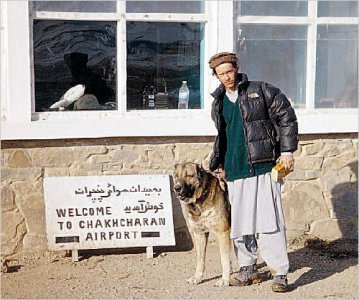
Rory Stewart and the the dog he walked with in Afghanistan. (I borrowed this picture from a blog.)
I am enjoying reading J. Maarten Troost (Dutch/ Czech CCK, and TCK via those countries plus Canada and the US). I taught a fun class yesterday in which I argued that despite the apparent low-brow title, The Sex Lives of Cannibals is actually rife with fairly sophisticated allusions to Jonathan Swift's Gulliver's Travels. It may seem there's too much poop in the narrative, but the point is satirical, and it is typically Troost and the First World that are objects of critique. America especially is critiqued . . . but that's easy. America in the 21st century is so easy to critique that it may in fact be cliche to do so.
Yesterday I also made mention of Rory Stewart (TCK via the UK and Malaysia, with impressive travel experience and Middle Eastern language acquisition as an adult), specifically The Place Inbetween and The Prince of Marshes. He aims for a different market, I think (no sex, drugs or rock and roll in his titles; lots of politics and history). He's a British politician now.
I wonder if TCA travel narratives differ from travel narratives by others?
Kira Salak (not TCK) goes to Papua New Guinea, Rosemary Mahoney (not a TCK) paddles the Nile, Bill Bryson (not a TCK) hikes the Appalachian trail, among other things.
What makes their works different from Stewart or Troost? Perhaps this: Troost and Stewart are very at home with outsider status. They observe it, they write about it, and they inhabit it fondly, and without fear. For Troost, dead geckos in the water cistern are not scary but another opportunity to poke fun at himself for looking like an idiot as he scours them out in the heat of the blazing sun. For Stewart, the walking paths across Afghanistan pose dangers, challenges and discomforts, but they are food for reflection, not anxiety.
Salak, by contrast, is often scared witless (will the trail through the jungle ever end?). Mahoney is continually anxious about how Muslim Egyptians will respond to her as a single, white woman alone in a boat. Bryson, while jokingly unafraid, is not fond of feeling an outsider: outsiderliness fuels his jokes, but more because he does not enjoy it than because he relishes it.
Rory Stewart and the the dog he walked with in Afghanistan. (I borrowed this picture from a blog.)
Sunday, August 24, 2014
Simultaneity (Mohsin Hamid)
I read Mohsin Hamid's (TCK via US and Pakistan) The Reluctant Fundamentalist and just attended his discussion of the work.
In brief (I'm tired: been a long day enjoying new students): what if it's not discontinuity that characterizes third culture literature, but simultaneity?
Hamid frames his novel as a protracted conversation between a Pakistani in Lahore and an American businessman. The Pakistani tells the American at length about his career in New York and the events that resulted in his return to his native Pakistan. Hamid argues that the frame (conversation in Lahore) and the topic (what happened in New York) mean that both places are inhabited simultaneously.
Boom! Mind=blown. I think this may be more apt than my argument about discontinuity in Ondaatje and others.
Throw in these details: the opening of Hamid's novel "Excuse me sir, but may I be of assistance?" as homage and reference to Albert Camus' The Fall which opens "May I, sir, offer my services without the risk of intruding?" and the fact that Camus was a kind of expat (raised in French Algeria) and there's a lot to free-associate with . . .
Camus' L'etranger: is it third culture literature? If it influenced existentialism, is existentialism founded in part on a kind of detachment and disenfranchisement specific to growing up expat?
And, I've badly wanted to write about The Doors (Jim Morrison was a military brat) and their lyrics. What connections, if any, are to be made between L'etranger and "People are Strange"?
Write to me. Tell me what you think.
In brief (I'm tired: been a long day enjoying new students): what if it's not discontinuity that characterizes third culture literature, but simultaneity?
Hamid frames his novel as a protracted conversation between a Pakistani in Lahore and an American businessman. The Pakistani tells the American at length about his career in New York and the events that resulted in his return to his native Pakistan. Hamid argues that the frame (conversation in Lahore) and the topic (what happened in New York) mean that both places are inhabited simultaneously.
Boom! Mind=blown. I think this may be more apt than my argument about discontinuity in Ondaatje and others.
Throw in these details: the opening of Hamid's novel "Excuse me sir, but may I be of assistance?" as homage and reference to Albert Camus' The Fall which opens "May I, sir, offer my services without the risk of intruding?" and the fact that Camus was a kind of expat (raised in French Algeria) and there's a lot to free-associate with . . .
Camus' L'etranger: is it third culture literature? If it influenced existentialism, is existentialism founded in part on a kind of detachment and disenfranchisement specific to growing up expat?
And, I've badly wanted to write about The Doors (Jim Morrison was a military brat) and their lyrics. What connections, if any, are to be made between L'etranger and "People are Strange"?
Write to me. Tell me what you think.
Friday, August 8, 2014
Terroir and Third Culture Literature
Vintners acknowledge the influence of the soil in which a vine is grown on the taste of the grape, and thus the taste of the wine. Terroir--loosely translatable as "sense of place"--matters in tangible, taste-able terms.
Third culture authors are not alone in their interest in food, nor is their acknowledgement that food is an essential part of culture, of what makes home. Home has a taste: literature writes about it over and over again.
Perhaps, though, third culture authors are more highly attuned than most to conflicts between the soil and the food. Kingsolver's Nathan Price (The Poisonwood Bible) plants a lavish vegetable garden that won't grow in the Belgian Congo because there are no pollinators for the American plants. In Alison's Natives and Exotics (which uses imported plants as a metaphor for dislocated people) a grove of orange trees dies of an imported blight.
In Lively's The Photograph a prominent character is a gardener who derides the recent vogue for imported pampas grasses . . . she too is aware of what is native and what is not.
TCKs are famously non-judgmental. All that cultural awareness makes us open-minded. Except, perhaps in the matter of food? I wonder if this is one area in which we allow ourselves to taste authenticity, belonging and terroir, and deride imports.
Third culture authors are not alone in their interest in food, nor is their acknowledgement that food is an essential part of culture, of what makes home. Home has a taste: literature writes about it over and over again.
Perhaps, though, third culture authors are more highly attuned than most to conflicts between the soil and the food. Kingsolver's Nathan Price (The Poisonwood Bible) plants a lavish vegetable garden that won't grow in the Belgian Congo because there are no pollinators for the American plants. In Alison's Natives and Exotics (which uses imported plants as a metaphor for dislocated people) a grove of orange trees dies of an imported blight.
In Lively's The Photograph a prominent character is a gardener who derides the recent vogue for imported pampas grasses . . . she too is aware of what is native and what is not.
TCKs are famously non-judgmental. All that cultural awareness makes us open-minded. Except, perhaps in the matter of food? I wonder if this is one area in which we allow ourselves to taste authenticity, belonging and terroir, and deride imports.
Thursday, August 7, 2014
Discontinuity
Yesterday I blogged about the possibility that the chameleonesque TCK worries that s/he has no authentic self. I cited Eleanor Catton's The Rehearsal.
Here's a different spin: if the TCK is a chameleon, exceptionally adept at adapting to different circumstances, perhaps the self which is fashioned in each distinct environment is a distinct self. For example, if Ondaatje is "Canadian" via Ceylon and the UK, maybe when he thinks of himself he imagines the Ceylonese boy as a whole different person, distinct from the UK public school boy, and certainly separate and different from the Canadian author.
If experiencing oneself as different kinds of people depending on where one is/was is true of other authors, then third culture literature bears it out in an array of ways.
- Time-lines are frequently discontinuous, or confounded. For example, both of Catton's novels which provide dates as chapter headings, but paired with such garbled plot lines they perplex rather than assist the reader. Or Susi Wyss's linked short stories in The Civilized World which are subtitled according to location and follow geography first and narative teleology second.
-Characters fail to know themselves. Ondaatje's protagonist in The Cat's Table calls himself "he" when writing of his childhood self. In his poem sequence Tin Roof, the speaker alternates between calling himself "I" and calling himself "You." Characters are schizophrenic (Wray's Lowboy), they are split in two (the separated Siamese twins in DBC Pierre's Ludmila's Broken English), they are actors (Catton's The Rehearsal).
-In Netherland O'Neill's Hans rifles through a box of photos. The pictures are of different selves in different eras. There is no honest way to put them in an album and imply they connect to one another. In Lively's The Photograph there is a picture of a woman which reveals that she had a whole other self, one no one knew about. In the poem Billy the Kid, Ondaatje includes many archival photos of Billy , but also includes one of himself as a child dressed as a cowboy! Amongst so many different selves, why not also be Billy the Kid?
Stylistically TCL features discontinuity. This too is one of its fingerprints.
Here's a different spin: if the TCK is a chameleon, exceptionally adept at adapting to different circumstances, perhaps the self which is fashioned in each distinct environment is a distinct self. For example, if Ondaatje is "Canadian" via Ceylon and the UK, maybe when he thinks of himself he imagines the Ceylonese boy as a whole different person, distinct from the UK public school boy, and certainly separate and different from the Canadian author.
If experiencing oneself as different kinds of people depending on where one is/was is true of other authors, then third culture literature bears it out in an array of ways.
- Time-lines are frequently discontinuous, or confounded. For example, both of Catton's novels which provide dates as chapter headings, but paired with such garbled plot lines they perplex rather than assist the reader. Or Susi Wyss's linked short stories in The Civilized World which are subtitled according to location and follow geography first and narative teleology second.
-Characters fail to know themselves. Ondaatje's protagonist in The Cat's Table calls himself "he" when writing of his childhood self. In his poem sequence Tin Roof, the speaker alternates between calling himself "I" and calling himself "You." Characters are schizophrenic (Wray's Lowboy), they are split in two (the separated Siamese twins in DBC Pierre's Ludmila's Broken English), they are actors (Catton's The Rehearsal).
-In Netherland O'Neill's Hans rifles through a box of photos. The pictures are of different selves in different eras. There is no honest way to put them in an album and imply they connect to one another. In Lively's The Photograph there is a picture of a woman which reveals that she had a whole other self, one no one knew about. In the poem Billy the Kid, Ondaatje includes many archival photos of Billy , but also includes one of himself as a child dressed as a cowboy! Amongst so many different selves, why not also be Billy the Kid?
Stylistically TCL features discontinuity. This too is one of its fingerprints.
Subscribe to:
Posts (Atom)